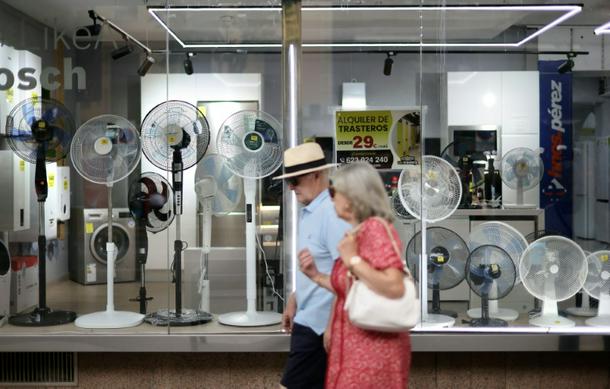
Scientists say that human activity -- primarily burning fossil fuels -- is heating the planet and fuelling extreme weather events
Paris (France) (AFP) - Europe’s climate monitor said Thursday that August was the hottest month ever recorded around the world and warned of worse to come, as an unprecedented El Nino pattern grows stronger.
Global temperatures over land and sea soared to all-time highs in August and capped an extreme summer of heatwaves and wildfires that ranked the hottest on record for western Europe and the contiguous United States.
The Copernicus Climate Change Service said global average air temperatures in August were 16.96C – surpassing by 0.01C the previous record for a single month set in July 2023. The EU monitor said it considered the two months joint-highest given the narrow difference.
Copernicus observations go back to 1940, but evidence from ice cores, tree rings and coral skeletons puts today’s climate in a much starker historical context.
“Humans haven’t seen temperatures as hot as today for, arguably, at least the last 100,000 years,” Samantha Burgess from the European Centre for Medium-Range Weather Forecasts, which oversees Copernicus, told AFP.
UN climate chief Simon Stiell said the “evidence is irrefutable: this is the spiralling price of humanity’s fossil fuel addiction”.
- ‘Striking’ -
The exceptional summer also drove ocean temperatures to record highs for three straight months, said Simon van Gennip from Mercator Ocean International on Thursday.
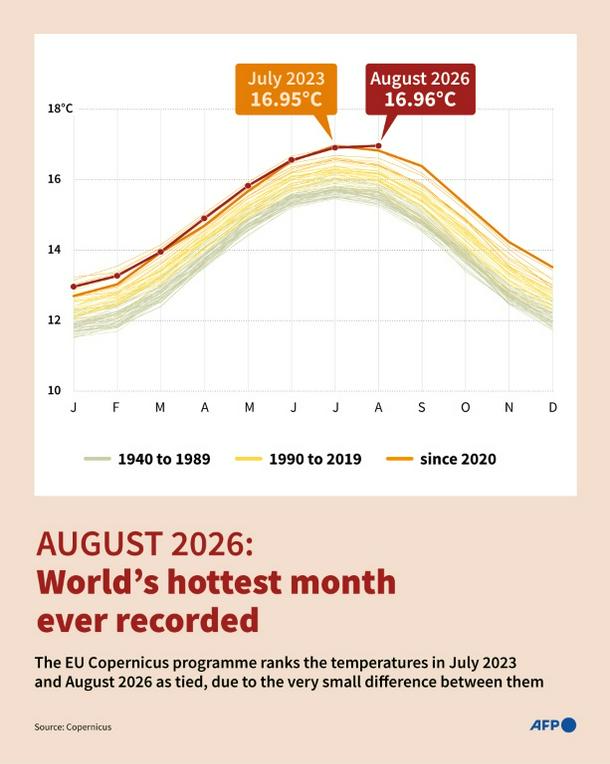
Infographic with a chart showing average monthly temperatures by year since 1940, and the record reached in August 2026, according to Copernicus data
Marine heatwaves have persisted in some overheated basins for more than 60 days, “highlighting just how unusual and persistent” the situation was, he said.
Global sea surface temperatures set a new all-time daily high in August and equalled the hottest month for oceans ever recorded.
Copernicus said the main driver was global heating from burning coal, oil and gas, but also sharp-rising temperatures in the Pacific, where a historic El Nino is gaining strength.
El Nino episodes are characterised by unusually warm Pacific waters but trigger major global changes in rainfall and winds, raising the odds of wild weather thousands of miles away.
Global forecasters predict this year’s event will peak later this year at an intensity never observed in the modern era.
On Thursday, the US National Oceanic and Atmospheric Administration (NOAA) said there was a 75 percent chance it “would exceed the strength of previous El Nino events dating back to 1950”.
Copernicus said its influence was already being felt in Indonesia, where a long, intense dry season has fed wildfires that have torched swathes of Borneo island.
But climate scientists said the worst was yet to come – and August’s extraordinary heat was just a preview.
Even ordinary El Nino episodes have a temporary warming effect, boosting global heat and compounding the impact of long-term climate change.
That extra heat often helps make the year after El Nino peaks the hottest on record globally.
Scientists expect 2027 to become a record-setting year but Burgess said 2026 could also prove historic.
“We expected 2026 to be top five but now it’s second place, maybe in first place… We’ve seen a striking reminder of how quickly the climate system can shift when multiple drivers have aligned,” she said.
The double whammy of climate change and El Nino would mean records “falling over the next six months”, said Burgess, an ocean scientist and strategic lead for at ECMWF.
“Climate change makes every El Nino hotter, and until we stop burning coal, oil, and gas these record-shattering months will simply keep on coming,” said Friederike Otto, a climate scientist from Imperial College London.
- Extremes -
Copernicus said that western Europe experienced its hottest summer, outstripping the long-standing 2003 record.
The season was marked by severe, back-to-back heatwaves that shut schools, dried up rivers and primed the land for devastating wildfires.
Between mid-July and mid-August, the continent’s EuroMomo monitoring platform estimated that Europe saw more than 32,000 excess deaths.
But it was abnormally hot elsewhere too – Copernicus said the June to August period was the equal-warmest globally on record, on par with 2024.
An AFP analysis of Copernicus data showed that regions home to around 900 million people lived through the hottest July ever observed.
And on Wednesday, NOAA said the contiguous United States has endured its hottest summer on record.
The summer has been “exceptional”, but the climate will “continue to get more extreme unless we turn off the tap to global emissions”, said Burgess.