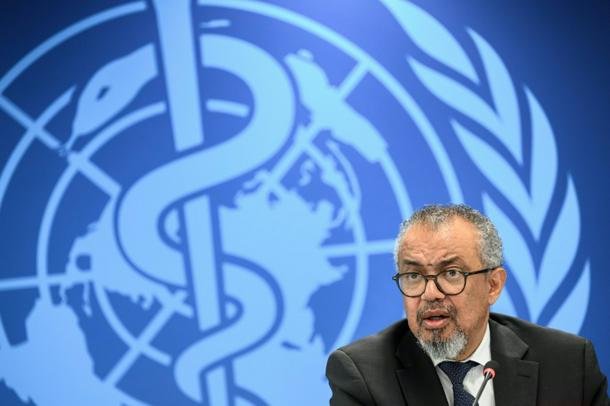
Tedros said the situation was 'especially challenging' as health workers scramble to catch up with the spread of the virus
Geneva (AFP) - The risk from the deadly Ebola outbreak has been raised to the highest level for the Democratic Republic of Congo, the World Health Organization said Friday, as the toll continued to rise.
There are now 82 confirmed cases and seven confirmed deaths in the DR Congo, with almost 750 suspected cases and 177 suspected deaths, the WHO said.
The outbreak, which experts suspect was circulating under the radar for some time, was caused by the less common Bundibugyo strain of Ebola, for which there are no approved vaccines or treatments.
The WHO is prioritising certain existing treatments to see how effective they might be in combating the strain.
- Situation ‘deeply worrisome’ -
WHO chief Tedros Adhanom Ghebreyesus said the situation was “especially challenging” as health workers scramble to catch up with the spread of the virus and track down contacts of everyone thought to be infected, in highly insecure areas.
“We know the epidemic in DRC is much larger” than the confirmed cases, he told journalists at the WHO headquarters in Geneva.
The situation in neighbouring Uganda was “stable”, with two cases confirmed in people who travelled from DRC and one death, with “intense contact tracing” seemingly having prevented further spread.
While a US national who was working in the DRC has tested positive and been transferred to Germany for care, Tedros said another US national deemed to be a high-risk contact had been transferred to the Czech Republic.
Ebola is a deadly viral disease spread through direct contact with bodily fluids. It can cause severe bleeding and organ failure.
The WHO upgraded its risk assessment level from high to very high for the DR Congo, while keeping the regional risk level at high and the global risk level at low.
The assessment determines the potential impact of a public health threat and the necessary response measures, with WHO advice set to follow.
The WHO’s emergency alert and response director Abdi Rahman Mahamud said the assessment looks at the potential risk for human health; the risk of an event spreading; and the capacity available.
“The potential of this virus spreading rapidly is very high, and that changed the whole dynamic,” he said.
- Catch-up phase -
Speaking from the field, Anne Ancia, the WHO’s representative in the DRC, said the case numbers would keep rising until all the response operations could be put in place.
The virus has been “rampant and silently disseminating for a few weeks already”, and “we are sprinting behind” playing catch-up, with the spread “not yet under control”, she explained.
When no treatments or vaccines are available, finding contacts and isolating them for 21 days “is the only way that we will be able to disrupt the transmission”.
More than 1,400 contacts were being traced in northeastern Ituri province, the outbreak’s epicentre, she added.
WHO’s Africa regional director Mohamed Yakub Janabi said Ebola had a so-called silent early phase, when symptoms resemble malaria or typhoid, meaning transmission can remain undetected.
Ancia said rising case numbers at this stage was a “good sign” because it showed that surveillance and active discovery of cases was working.
Janabi added that “it often reflects that the response is intensifying, uncovering the true scale of the outbreak”.
- Treatment trials planned -
There have only been two previous outbreaks of Bundibugyo, in Uganda in 2007 and DRC in 2012.
With no approved treatments or vaccines for Bundibugyo, WHO chief scientist Sylvie Briand said the UN agency was prioritising all existing tools that might be useful in combating the outbreak.
The WHO research and development branch’s technical advisory group on treatments has prioritised two monoclonal antibodies for clinical trials: Regeneron 3479 and Mapp Biopharmaceutical’s MBP134.
It also recommended evaluating the oral antiviral obeldesivir in clinical trials as post-exposure prophylaxis for people who are high-risk contacts.
Briand said it looked “promising” as something that might be able to prevent infected contacts from going on to develop disease from that infection.
- No swift vaccine options -
As for vaccines, the Ervebo vaccine works against the Zaire strain of Ebola but there is “very little evidence of cross-protection for Bundibugyo”, said Briand.
While a Bundibugyo-specific equivalent has been worked on, there are no doses currently available for clinical trials, and if prioritised, it could take six to nine months to develop.
And while a candidate vaccine targeting Bundibugyo and leveraging the ChAdOx platform is in production, there is not yet any data from animal testing to support going forward for clinical trials on humans, said Briand.