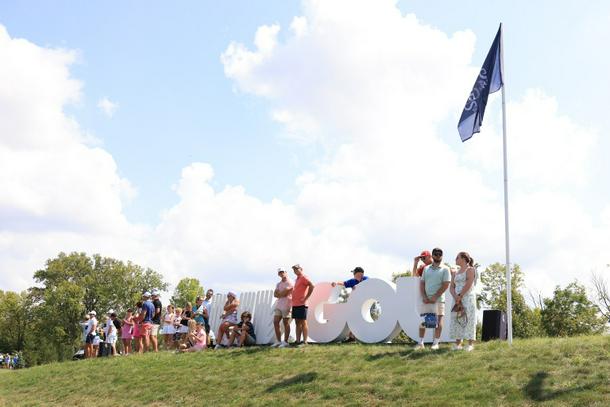
Fans gather around a LIV Golf sign at LIV Golf Indianapolis in August 2026
New York (AFP) - The rebel LIV Golf tour will shut down after five years that rocked the global game, saying Thursday that an effort to relaunch after losing its original Saudi backers has been scrapped.
The announcement follows reports that BC Partners Credit, the lead investor in “LIV 2.0,” had withdrawn from the project after struggling to convince several star players to fully commit to the league going forward.
In a statement, LIV Golf said only that attempts to implement its Restructuring Support Agreement with BC Partners had foundered.
“Despite extensive discussions, the relevant parties were ultimately unable to reach a consensual resolution of certain outstanding terms of the Transaction contemplated by the RSA,” LIV Golf said. “In light of the current circumstances, we believe shifting toward an orderly wind-down is the most responsible path forward for the League at this time.”
The statement confirmed LIV attorney Matthew Williams’s statements in a 13-minute hearing in bankruptcy court in New Jersey on Thursday.
The once free-spending Saudi-backed league that had turned the golf world upside-down by luring superstars away from the traditional PGA Tour will begin liquidating its remaining assets on Monday, the court heard.
Saudi Arabia’s Public Investment Fund (PIF) had poured an estimated $5 billion into the tour since 2022, before abruptly pulling the plug earlier this year.
LIV formally filed for bankruptcy protection in September, though officials vowed to relaunch as “LIV 2.0” next season with a shorter schedule and reduced prize money, and equity stakes in the league for players.
BC Partners Credit had pledged an initial funding commitment of a potential $300 million.
But several former LIV stars including Jon Rahm publicly announced their decisions to withdraw from the new version of the tour in recent weeks. Several others were believed to be on the fence.
Even Bryson DeChambeau – arguably the breakaway circuit’s biggest name, who continued to back the tour – did not publicly commit to returning.
BC Partners Credit said in a statement that there was “great support” for a revamped LIV circuit, but that ultimately no agreement on terms could be reached.
“BC Partners supported a transaction that aligned the interests of players and investors, offering a credible path toward building a sustainable future for LIV Golf,” the company said.
“While there was great support for the league, we are disappointed that mutually acceptable terms could not be reached among the various stakeholders.
“We commend LIV Golf’s management for their tireless efforts and thank the players who supported the future of LIV and engaged constructively throughout.
“We wish them every success as the continue their careers.”
LIV Golf said it would remain open to and consider “any value-maximizing alternatives with third parties that may arise as the company is wound up.
- ‘Round of a lifetime’ -
“Building a global platform designed to bring new, younger, and more diverse fans to the sport of golf has been the round of a lifetime for all of us,” LIV Golf chief executive Scott O’Neil said in a statement. “LIV Golf was fun, demanding, inspiring, at times challenging — but always rewarding.
“Together, our team delivered world-class individual and team competitions across five continents, built a global business, secured pathways to The Open and US Open, earned Official World Golf Ranking points, engaged with stakeholders focused on the health and future of the game, created value in our teams, attracted premier sponsors, brought investors to the table around a next-generation business plan, and built a league capable of attracting both elite and rising talent from around the world.”
Documents from bankruptcy filings showed that LIV owes between $500 million and $1 billion in estimated liabilities to at least 1,000 creditors, including star players.
Rahm, DeChambeau and fellow golfer Dustin Johnson hold the largest unsecured claims against the tour, totaling more than $5 million each in immediate past-due payments.